
Why the Pomodoro Technique for Studying Can Transform Your Grades
The pomodoro technique for studying is one of the most effective ways to beat procrastination and actually retain what you learn. Here’s the quick version:
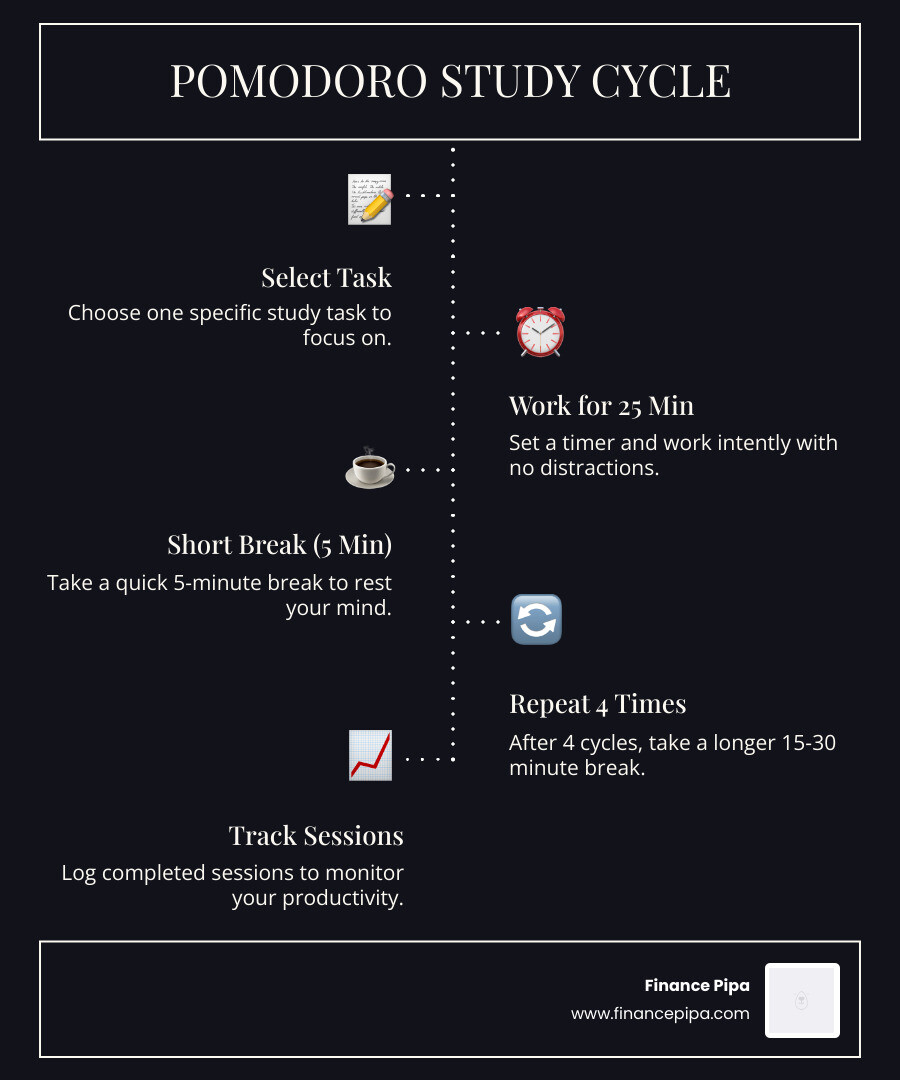
How the Pomodoro Technique works for studying:
- Pick one specific task (e.g., “Read pages 40–55 of biology textbook”)
- Set a timer for 25 minutes and work with zero distractions
- Take a 5-minute break when the timer rings
- Repeat 4 times, then take a longer 15–30 minute break
- Track each completed session to see your progress build
We’ve all been there. You sit down to study for two hours, and somehow 90 minutes later you’ve reorganized your browser tabs, replied to three messages, and learned almost nothing.
That’s not a laziness problem. It’s a structure problem.
The Pomodoro Technique was born from exactly this frustration. In the late 1980s, a university student named Francesco Cirillo was struggling with burnout and poor focus. He made a simple bet with himself: could he concentrate for just 10 minutes straight? He grabbed the only timer nearby — a tomato-shaped kitchen timer (“pomodoro” is Italian for tomato) — and got to work. That small experiment grew into one of the most widely used productivity methods in the world.
The reason it spread so fast? It actually matches how your brain works.
Most people can only maintain peak focus for 20–40 minutes before attention starts to slip. The Pomodoro Technique doesn’t fight that limit — it works with it. Short, timed bursts of focus followed by real breaks keep your brain sharp session after session, replacing hours of distracted “studying” with far less time of actual learning.
The Science Behind the Pomodoro Technique for Studying
Why does a simple kitchen timer feel like a productivity superpower? It isn’t magic; it’s cognitive science. Our brains are not designed to maintain high-intensity focus for hours on end. Research on sustained attention consistently shows that most people experience a significant drop in focus after just 20 to 30 minutes of continuous work. This is known as “vigilance decrement.”
When we try to force ourselves through a four-hour library marathon, we aren’t actually studying for four hours. We are performing “endurance theater.” Our eyes move across the page, but our minds are doing parkour off every available surface. By using the pomodoro technique for studying, we create a “timer fence” that protects our attention.
As explained in The Pomodoro Technique — Why it works & how to do it, this method manages our cognitive load. Our working memory has a limited capacity—roughly 7±2 pieces of information at once. When we overload it without giving it a rest, we stop processing new data. The 5-minute break acts as a “reset button” for your prefrontal cortex, the part of your brain responsible for decision-making and focus.
Furthermore, the pomodoro technique for studying combats the “multitasking drain.” Statistics show a 40% productivity loss when we switch between tasks. Every time you check a “quick” notification, your brain pays a “switching cost.” It takes time to get back into the flow. The Pomodoro method eliminates this by demanding 100% focus on a single task for a set duration.

Why the Pomodoro Technique for Studying Beats Cramming
We’ve all been tempted to pull an all-nighter before a final, but science suggests that’s the worst way to learn. Distributed practice—spacing out your study sessions—has been shown to outperform cramming in 96% of academic studies.
The pomodoro technique for studying naturally implements this “spacing effect.” By breaking your day into intervals, you are giving your brain time for memory consolidation. During those short 5-minute breaks, your brain isn’t just “off”; it is busy moving information from your short-term working memory into long-term storage.
According to the Pomodoro Technique | Dietrich School of Arts & Sciences, this method also leverages the Zeigarnik effect. This is a psychological phenomenon where our brains remember uncompleted or interrupted tasks better than completed ones. By stopping a session while you’re in the middle of a thought, your subconscious continues to chew on the problem during your break. You might find that the “Aha!” moment for a difficult math problem comes while you’re grabbing a glass of water, not while staring at the paper.
Overcoming the “Switching Cost” with Focused Intervals
Have you ever felt “task residue”? This happens when your mind lingers on a previous task even after you’ve moved on to something new. Research indicates it can take over 20 minutes to regain full concentration after an interruption.
The pomodoro technique for studying solves this by creating deep work “sprints.” By committing to 25 minutes of zero-interruption work, you bypass the shallow state of constant switching and enter a “flow state.” This is where the real learning happens. Instead of paying the 20-minute recovery tax every time your phone pings, you bank that time into actual progress.
Step-by-Step: Mastering the Pomodoro Technique for Studying
Ready to start? Don’t just set a timer and hope for the best. To truly master the pomodoro technique for studying, you need a system.
- Select Your Task: Be specific. Instead of “Study Biology,” choose “Summarize Chapter 4 and complete 10 practice questions.”
- Set the Timer: 25 minutes is the gold standard for beginners.
- Work with Single-Tasking Focus: If a thought pops into your head (like “I need to buy milk”), write it down on a “Parking Lot” list and immediately return to your study task.
- The Short Break: When the timer dings, stop immediately. Take 5 minutes to stretch, hydrate, or look out a window. No screens!
- The Long Break: After you have completed four “Pomodoros,” take a 15–30 minute break. This is your reward. Eat a snack, take a walk, or check your phone.

Planning Your “Tomato” Estimates
The secret to a stress-free study day is “thinking in tomatoes rather than hours.” Before you start, look at your to-do list and estimate how many Pomodoros each task will take.
| Study Task | Estimated Pomodoros |
|---|---|
| Read 15 pages of textbook | 2 Pomodoros |
| Draft essay introduction | 1 Pomodoro |
| Practice 10 Calculus problems | 3 Pomodoros |
| Review flashcards (Active Recall) | 1 Pomodoro |
If a task is too big (e.g., “Write 2,000-word paper”), break it into “atomic units” that fit into 1–2 sessions. If you finish a task early, don’t switch gears immediately. Use the remaining time for “overlearning”—reviewing what you just did or prepping for the next block. This reinforces the habit and ensures session integrity.
Customizing the Pomodoro Technique for Studying for Different Subjects
While 25/5 is the classic rhythm, it isn’t set in stone. As you become more experienced, you should adapt the pomodoro technique for studying to fit the subject matter.
- For Reading & Memorization (25/5): Short bursts are perfect for active recall and flashcards.
- For Problem Solving (40/10 or 50/10): Complex subjects like Math or Physics often require more time to reach a “flow state.” A 50-minute work session followed by a 10-minute break might feel more productive.
- For Deep Writing or Research (90/20): This aligns with your body’s “ultradian rhythms,” which are natural 90-minute energy cycles.
As noted in Pomodoro for Students: A Simple Study System That Actually Works, the goal is to find the “sweet spot” where you are productive but not burned out. Try the standard 25/5 for two weeks before you start experimenting with longer cycles.
Best Practices for Breaks and Distraction Management
The break is 50% of the technique. If you spend your 5-minute break scrolling through TikTok or Instagram, you aren’t actually resting your brain. You are just replacing one form of cognitive load with another.
The Golden Rules for Pomodoro Breaks:
- Get away from your screen: Your eyes need a break from the “glowing hypnosis” of the monitor.
- Move your body: Stand up, stretch, or do a quick lap around the room. This boosts blood flow to the brain.
- Hydrate and Refuel: Drink water or grab a piece of fruit.
- Manage Interruption: If someone tries to interrupt your “sprint,” use the “Inform, Negotiate, Schedule” strategy. “I’m in the middle of a focus session. Can we talk in 15 minutes?”
Common Pitfalls and How to Avoid Them
Even the best students stumble when they first try the pomodoro technique for studying. Here is how to stay on track:
- The “Just One More Minute” Trap: When the timer rings, stop. Even if you’re mid-sentence. This trains your brain to value the time you do have.
- Skipping Breaks: You might feel like you’re “on a roll,” but skipping breaks leads to a massive crash later in the day. Respect the rest.
- The Phone Addiction: Put your phone in another room. If you use it as your timer, put it on “Do Not Disturb.”
- Unrealistic Targets: Don’t aim for 16 Pomodoros on your first day. Most students find that 6–8 high-quality sessions (3–4 hours of total focus) are more than enough to outperform a whole “distracted” afternoon.
As discussed in The TRUTH About the Pomodoro Technique, the technique fails when people become too rigid or use it as a way to punish themselves. The tomato is a tool, not a drill sergeant. If you have ADHD or find 25 minutes too long, start with 15. The goal is consistency, not perfection.
Frequently Asked Questions about Pomodoro Studying
How many Pomodoros should I aim for in a day?
For a standard study day, 6–8 Pomodoros is a healthy, sustainable target. This equals about 3–4 hours of deep, focused work. During heavy exam prep, you might push to 10–12 sessions, but be sure to take much longer breaks between every four-cycle block to avoid mental fatigue. Quality always beats quantity.
What should I do if I finish a task before the timer rings?
Do not stop the timer and do not switch to a completely new subject! Use the “overlearning” rule. Review the notes you just took, look for gaps in your understanding, or spend the last five minutes organizing your materials for the next session. This reinforces the information and keeps your “focus muscle” strong.
Can I listen to music during my Pomodoro sessions?
Yes, but be careful. Music with lyrics often engages the language-processing parts of your brain, which can interfere with reading or writing. We recommend lo-fi beats, classical music, or white noise. These act as “environmental triggers” that tell your brain it’s time to focus.
Conclusion
The pomodoro technique for studying is more than just a timer; it’s a way to reclaim your time and your sanity. By breaking the cycle of procrastination and burnout, you can actually enjoy your study sessions and still have time for a life outside the library.
At Finance Pipa, we believe in studying smarter, not harder. Our integrated study productivity suite—featuring tools for notes, focus tracking, and revision planning—is designed to help you implement methods like the Pomodoro Technique with ease. Whether you’re preparing for a minor quiz or your final thesis, having the right structure is the key to academic success.
Ready to see the difference? Grab your timer, pick your first task, and start your first “tomato” today. You’ve got this!
