
The Best Apps to Keep Track of Assignments in 2026
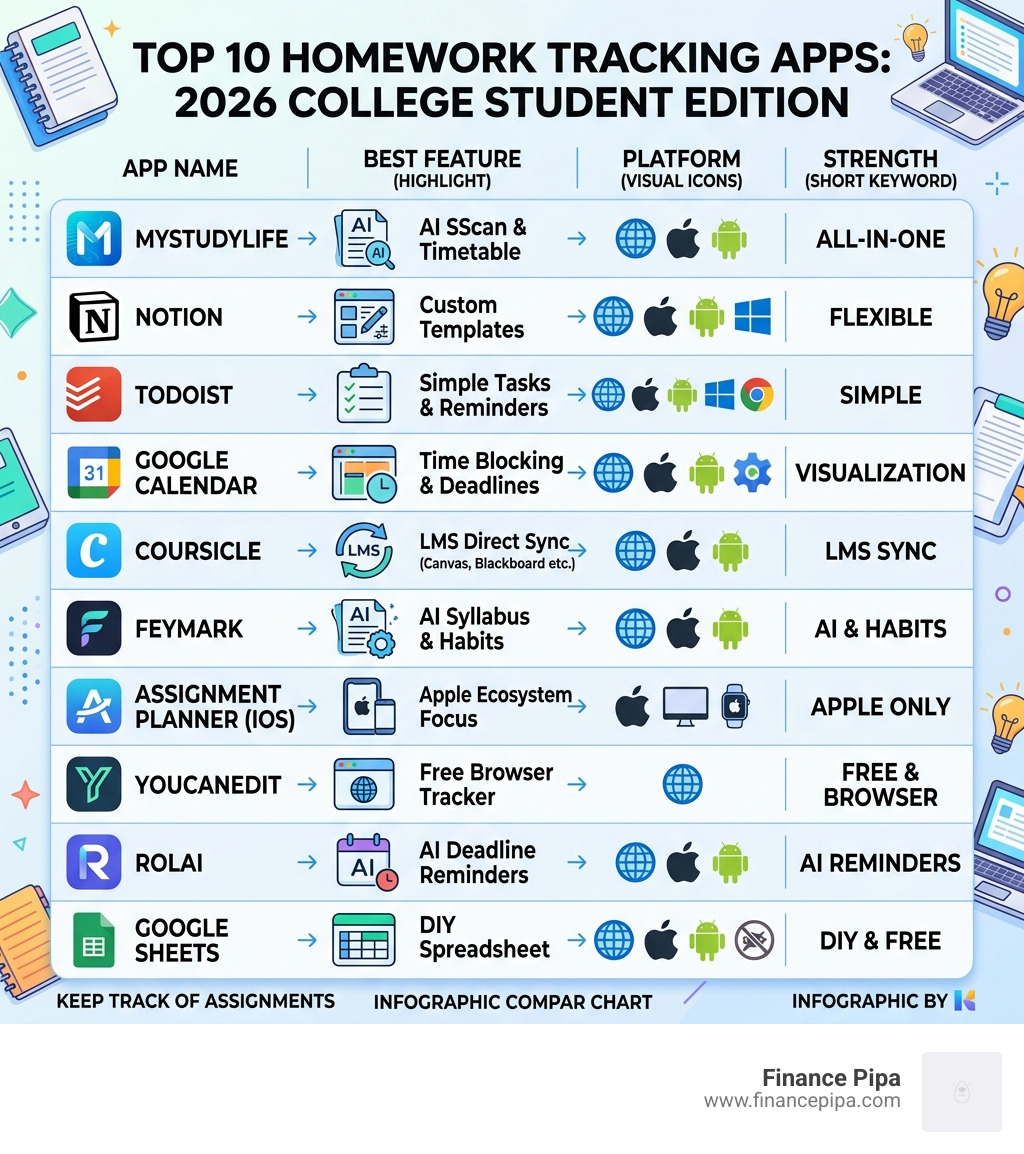
If you want to keep track of assignments without losing your mind, here are the top homework tracking solutions worth your time:
- Integrated Student Planners – Best for all-in-one management with AI timetable scan
- Customizable Workspaces – Best for flexible, template-based tracking
- Task Managers – Best for simple task lists with reminders
- Digital Calendars – Best for time-blocking and deadline visualization
- LMS Sync Tools – Best for syncing directly with Canvas, Blackboard, and other platforms
- AI Syllabus Extractors – Best for automated deadline detection and habit tracking
- Ecosystem-Specific Apps – Best for users dedicated to a single device family
- Browser-Based Trackers – Best for free, no-install accessibility
- AI-Powered Reminders – Best for smart, predictive deadline alerts
- Custom Spreadsheets – Best for a free, DIY approach to tracking
College is chaotic. Between syllabi dropped on day one, deadlines buried inside Canvas modules, and group projects scattered across three different platforms, it’s shockingly easy to miss something important — even when you’re trying to stay on top of it.
Sound familiar? You’re not alone. Over 24 million students worldwide use dedicated apps just to manage their academic workload. And there’s a good reason for that.
Missing assignments doesn’t just hurt your grade on one quiz. It chips away at your GPA, spikes your stress, and — if it becomes a pattern — puts graduation itself at risk.
The good news? The right app can fix most of this automatically.
Below, we’ve rounded up the 10 best homework tracking solutions for 2026, covering everything from simple free tools to AI-powered planners that read your syllabus for you.
Why You Must Keep Track of Assignments in 2026
In 2026, the academic landscape is more digital and demanding than ever. We’ve moved past the days when a single physical notebook could hold your entire academic life. Today, effectively choosing to keep track of assignments is a direct contributor to GPA improvement and long-term career readiness.
When we stay organized, we aren’t just avoiding a “zero” in the grade book; we are implementing quality control over our work. By tracking deadlines early, we give ourselves the “buffer time” needed to proofread, seek peer reviews, and actually digest the material rather than just rushing to hit “submit” at 11:59 PM. Research shows that Getting Middle School Students to Actually Turn in Their Homework is the first step toward building the executive function skills required for university and professional life.
Furthermore, being part of a global community of 24 million students using digital productivity tools proves that organization is a collective priority. Effective tracking reduces the “cortisol spikes” associated with forgotten exams and ensures that your academic performance reflects your actual intelligence, not just your ability to remember a date mentioned once in a lecture.
Common Challenges in Assignment Management
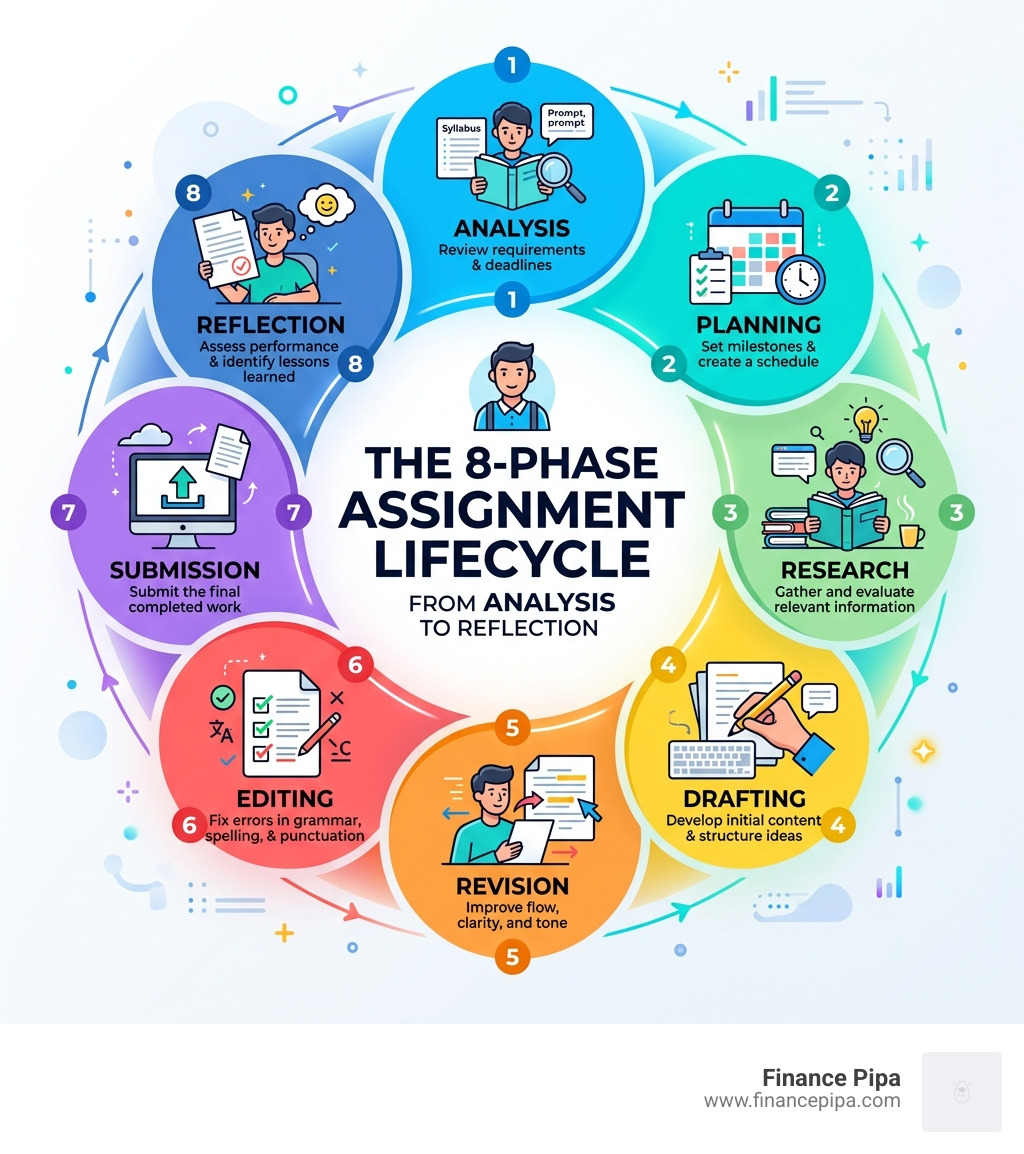
If staying organized were easy, everyone would have a 4.0 GPA. We often see students struggling not because they lack ambition, but because they are overwhelmed by “LMS sprawl”—the phenomenon where assignments are scattered across Canvas, Blackboard, Moodle, and Google Classroom.

Why Students Struggle to Keep Track of Assignments
Many of us face “executive function fatigue.” This is especially true for students with ADHD, who may find it difficult to sift through the visual noise of online portals to find actual due dates. Sometimes, deadlines are “hidden” inside specific modules or PDF syllabi rather than appearing on the main dashboard.
The complexity of modern syllabi, combined with the lingering effects of pandemic-related learning shifts, means our brains are often working overtime just to figure out what is due, leaving little energy for the actual work.
Overcoming Procrastination and Missed Deadlines
To beat procrastination, we recommend the 25% Rule: always estimate how long a task will take, then add a 25% buffer for unexpected hiccups.
- Batch Processing: Group similar tasks together (like doing all your weekly discussion posts in one sitting) to maintain flow.
- Energy Management: Tackle high-effort assignments during your peak brain hours and save “low-brain” tasks, like filing or formatting, for when you’re tired.
- Milestone Celebrations: Don’t wait until the end of the semester to reward yourself. Celebrate finishing a heavy research phase to keep your motivation high.
| Distraction Type | Impact Level | Strategy to Overcome |
|---|---|---|
| Social Media Reels | High | Use “Focus” modes or blocking apps |
| “SaaS Sprawl” | Medium | Centralize tasks in one dashboard |
| Hidden Deadlines | High | Use AI syllabus extraction tools |
| Heavy Planners | Low | Switch to mobile-first digital tracking |
Top Methods to Keep Track of Assignments Effectively
There is no one-size-fits-all way to keep track of assignments, but most successful students use a combination of these three methods:
- Paper Planners: Great for tactile satisfaction. There is a unique joy in physically crossing off a task. However, they don’t send notifications and can be heavy to carry.
- Digital Calendars: Digital calendar tools are elite for “time-blocking”—seeing exactly when you are in class versus when you have free time.
- Assignment Spreadsheets: A popular “TikTok-inspired” method involving a simple cloud-based spreadsheet with columns for Course, Assignment, Due Date, and Priority. It’s free and highly customizable.
Using Digital Tools to Keep Track of Assignments
Digital tools offer something paper can’t: Cloud Synchronization. Whether you are on your laptop in the library or checking your smartwatch between classes, your list is always there. Advanced study productivity suites now integrate these lists with automated reminders, so you never have to manually check if something is due tomorrow.
Traditional vs. Digital Tracking Systems
While a paper planner is a one-time purchase, a digital system can be surprisingly affordable. Some open-source trackers are maintained for as little as $14.18 per year (the cost of a domain registration), while others are completely free. Digital systems win on privacy-focused features and the ability to sync across various mobile and desktop devices, ensuring you aren’t tethered to a physical book.
Essential Features of a Modern Assignment Tracker
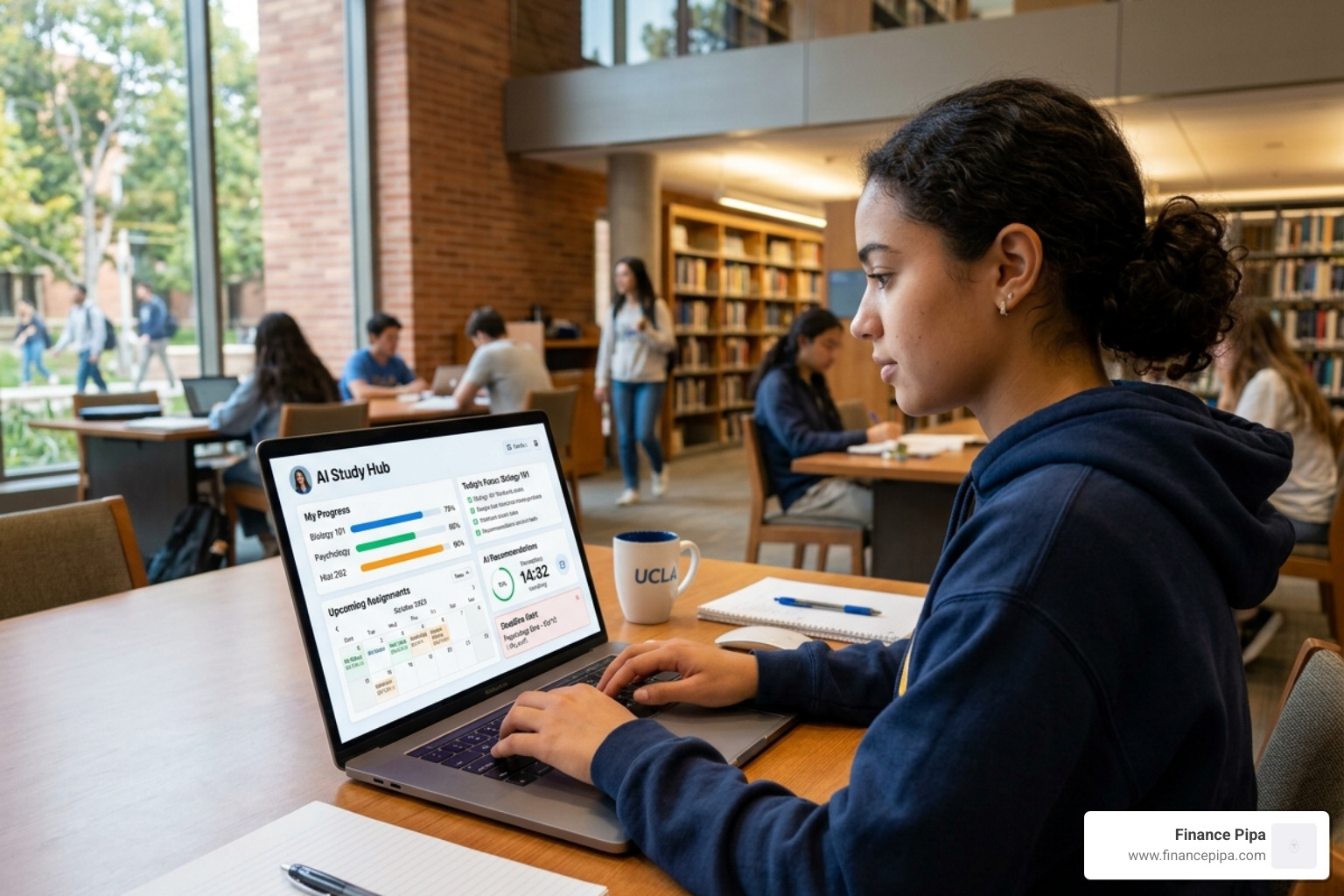
When we look for the “ultimate” tracker, we look for features that move beyond a simple to-do list. A modern system should act as a command center for your academic life.
Hallmark features include:
- AI Timetable Scanning: Take a photo of your paper schedule and let the app build your calendar.
- Syllabus Extraction: Upload a PDF, and the AI finds every deadline automatically.
- Pomodoro Timers: Built-in timers to help you stay focused for 25-minute sprints.
- Subtask Breakdown: Because “Write Research Paper” is too big, but “Find 5 Sources” is manageable.
- Dark Mode: Because we know you’re doing homework at 2 AM.
How Technology and AI Enhance the Tracking Process
AI isn’t just for writing essays (which you shouldn’t do anyway!). In tracking, AI provides Predictive Analytics. It can look at your past behavior and perform a Time Accuracy Analysis. For example, if you estimated a math set would take one hour but it actually took two, the AI adjusts your future schedule.
Expert data suggests students should plan for:
- Reading: 15-20 pages per hour.
- Math Problems: 10-15 minutes per complex problem.
- Research Papers: 1-2 hours of prep per finished page.
How to Organize and Prioritize Your Workload
Not all assignments are created equal. We suggest using Grade Weighting to decide what to do first.
- High Priority (>15% of grade): These are your “Big Rocks”—exams and term papers. Color-code these in Red.
- Medium Priority (5-15% of grade): Weekly quizzes or labs. Color-code in Yellow.
- Low Priority (<5% of grade): Participation or minor homework. Color-code in Green.
By using Backward Planning, you start at the due date and work your way to the present, setting “mini-deadlines” for each phase of the project.
The Role of Parents and Educators in Assignment Tracking
For younger students or those needing extra support, features like “Family Connect” allow parents to see upcoming deadlines without micromanaging every minute. Educators also play a role by ensuring deadlines are clearly labeled in the LMS. At home, creating a Supportive Environment is key—this includes workspace optimization (a clean desk) and using noise-canceling tools to minimize electronic distractions.
Frequently Asked Questions about Assignment Tracking
How do I prioritize assignments with similar due dates?
Use the Priority Classification method. If two things are due Friday, but one is worth 20% of your grade and the other is worth 2%, the 20% task gets your “peak energy” hours.
Can AI really help me organize my school schedule?
Yes! Modern apps use AI to scan syllabi and extract dates, saving you hours of manual data entry. They can also suggest the best times to study based on your existing class schedule.
What is the best way to avoid forgetting digital submissions?
Set Automated Reminders for 24 hours before and 2 hours before the deadline. Many students finish the work but forget to hit “upload.” A “Turn In” reminder is just as important as a “Do Work” reminder.
Conclusion
Don’t just track assignments, master your academic journey. The key to academic efficiency and stress reduction lies in an integrated study productivity suite that brings together all the essential features discussed. Finance Pipa offers a comprehensive solution designed to help you not just keep track, but truly graduate with confidence.
Our tools—including Notes, Focus, and Planner—are built to streamline your workflow and eliminate the “SaaS sprawl” that leads to missed deadlines. By centralizing your academic life, you can stop “winging it” and start achieving.
