
You’re Probably Wasting Money on Study Help You Don’t Need
Free revision apps can replace expensive tutors and paid study tools for most students. Here are the essential features to look for in a study suite:
| Feature | Best For | Completely Free? |
|---|---|---|
| AI Flashcards | Automated active recall and mock exams | Yes |
| Spaced Repetition | Long-term memory retention | Yes |
| Digital Planners | Organizing notes and progress tracking | Yes |
| Focus Timers | Concentration and distraction blocking | Yes |
| Curriculum Content | Subject-specific knowledge | Yes |
Tutors are expensive. Revision guides cost money. And somehow, exam season still sneaks up on you.
The good news? You don’t need to spend a penny to study smarter.
There are genuinely powerful free apps that use the same science as professional tutors — things like spaced repetition, active recall, and AI-generated quizzes — all sitting on your phone, waiting to be used.
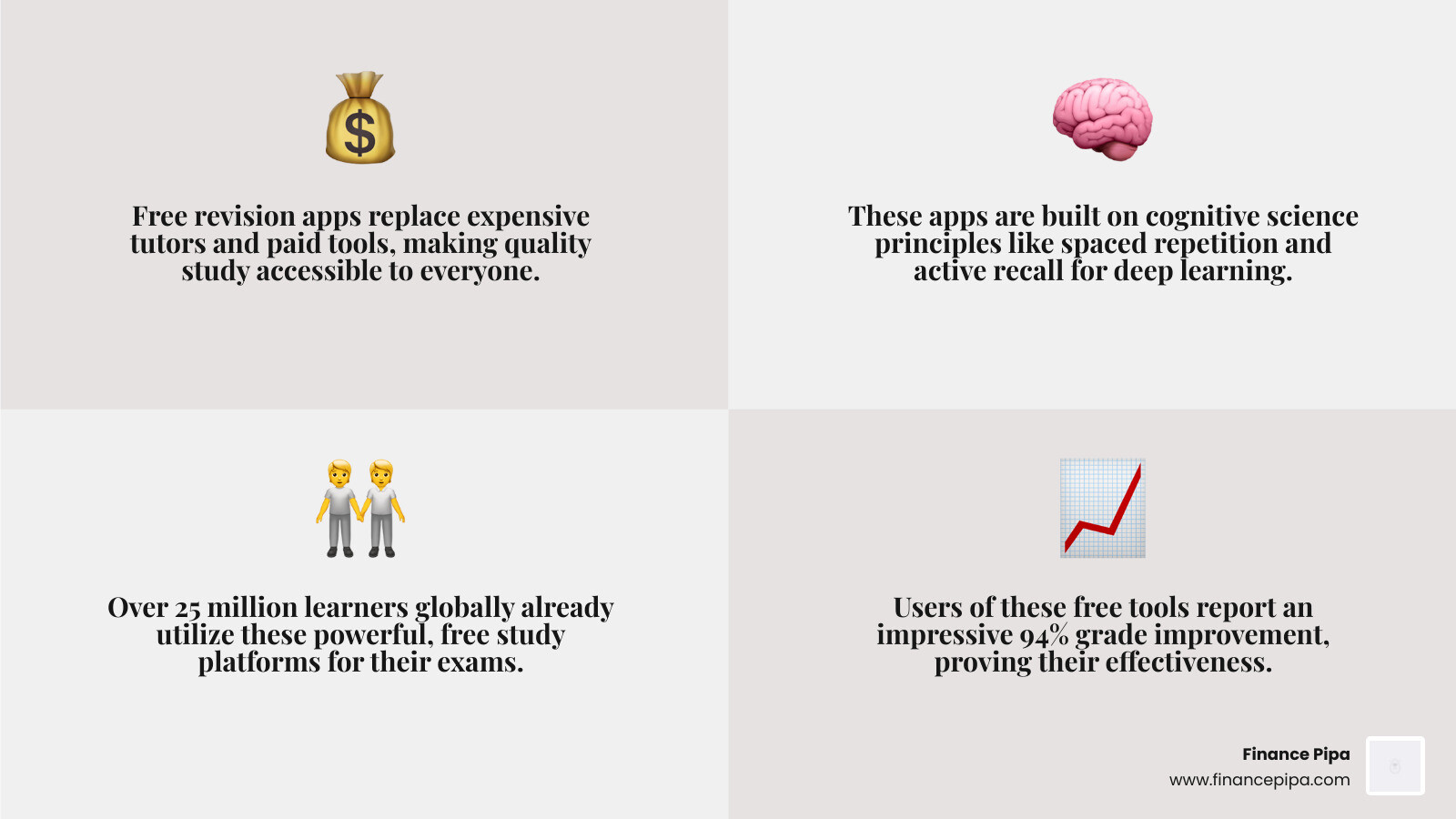
Millions of learners already use advanced digital study tools to improve their grades. In fact, 94% of students using these scientific methods report better academic performance.
The problem isn’t access to good study tools. It’s knowing which ones are actually worth your time — and which ones just look useful while quietly eating into your focus.
This guide cuts through the noise. We’ve rounded up the best features of free revision apps for students who need to study smarter, stay organized, and actually remember what they’ve learned.
The Science Behind the Best free revision apps

The most effective free revision apps aren’t just digital versions of your paper notes; they are built on decades of cognitive science. When we look at why some students excel while others struggle, it often comes down to how they interact with information. Apps that leverage active recall, spaced repetition, and metacognition are designed to move knowledge from your short-term memory into long-term retention.
Active recall is the process of challenging your brain to retrieve information without looking at the answer. Instead of passively reading a textbook—which often leads to a false sense of “fluency”—tools like flashcards force your brain to work. This effort strengthens the neural pathways.
Then there is spaced repetition. This technique involves reviewing information at increasing intervals. If you get a flashcard right, the app shows it to you less often. If you struggle, it appears more frequently. Many spaced repetition platforms use a “confidence-based” system where you rate how well you knew an answer on a scale of 1-5. This is metacognition in action: thinking about your own thinking.
Research highlights how digital platforms can make these complex scientific principles accessible to everyone. As outlined in this guide to 7 of the best free online revision tools, neuroeducation-backed tools emphasize that spacing out sessions and maximizing feedback are the keys to making learning “stick.” With millions of learners using these advanced methods, it’s no wonder that 94% of users in some studies report significant grade improvements.
Leveraging AI in free revision apps
The biggest shift in 2026 has been the integration of AI into our study routines. We no longer have to spend hours manually writing out flashcards. Modern free revision apps now feature AI-powered quiz generators that can scan your lecture slides or handwritten notes and instantly create study guides.
For example, advanced revision tools allow you to drop in a PDF of your lecture notes, and the AI will generate flashcards and mock exams for you. This doesn’t just save time; it ensures that your testing materials are comprehensive. Other intelligent study assistants act as a personalized research buddy. You can upload your sources, and the AI will help you summarize complex topics or even generate a “podcast” style audio summary of your notes.
The beauty of these AI tools is their ability to personalize learning. They identify your weak spots and suggest specific areas to focus on, effectively acting as a digital tutor that is available 24/7.
Why Students Prefer free revision apps for Mobile
Let’s be honest: we always have our phones on us. Mobile-first study apps have turned “dead time”—like sitting on the bus or waiting for a coffee—into productive microlearning sessions.
Students prefer mobile free revision apps because they offer:
- On-the-go revision: Study five flashcards while waiting in line.
- Offline mode: Many apps allow you to download study sets so you can revise without using data.
- Push notifications: Gentle reminders to stick to your revision timetable.
- Cross-platform sync: Start a session on your laptop and finish it on your phone.
By breaking down massive subjects into bite-sized chunks, these apps make the daunting task of exam prep feel manageable.
Top Tools for Organization and Retrospective Timetables

One of the biggest hurdles in revision isn’t the content itself, but the organization. Traditional revision timetables often fail because they are too rigid—life happens, and once you miss one study block on a Tuesday, the whole schedule falls apart.
This is where retrospective timetables come in. Instead of planning what you will do, you track what you have done and how confident you feel about it. Digital spreadsheets are a fantastic, completely free tool for this. You can list your topics in the first column and use the following columns to mark the dates you revised them, color-coding them based on your confidence (e.g., Red for “clueless,” Green for “mastered”).
As noted in expert study guides, using digital spreadsheets or flexible workspace apps for this purpose allows for a flexible workspace that grows with your progress.
For those who prefer a more structured approach, digital planners and calendar apps are excellent for tracking exam dates, deadlines, and study blocks. These apps send you alerts so you never miss a submission or an exam morning. By combining a task manager with a digital study planner, you can visualize your entire exam season at a glance.
Focus and Productivity: Gamifying Your Study Sessions
We’ve all been there: you sit down to revise, and three hours later, you realize you’ve been scrolling through social media for most of it. Staying focused is a skill, and fortunately, there are free revision apps designed to help you build it.
The Pomodoro Technique is a classic method involving 25 minutes of intense focus followed by a 5-minute break. Simple timer apps can manage this, but gamified focus tools make it more engaging. In these tools, you might plant a virtual tree that grows while you study or earn rewards for staying off distracting apps. It sounds simple, but the psychological urge to protect your progress can be a powerful deterrent against distractions.
For more aggressive distraction blocking, apps designed to block specific websites or apps during your study hours can help you create a “digital detox” environment. These tools ensure your concentration remains unbroken. Preventing burnout is just as important as the study itself, and these apps remind you to take those vital breaks to keep your brain fresh.
Mastering Writing and Active Recall with Digital Tools
Revision isn’t just about memorizing facts; it’s also about being able to communicate them effectively in an exam. Writing improvement tools have become essential for students tackling essay-based subjects.
Advanced writing assistants are standout free tools that help students polish their English compositions. They offer advanced grammar checks, vocabulary enhancement, and even sentence diagramming. This is particularly useful for multilingual students or those looking to elevate their academic tone.
Beyond grammar, digital note-taking tools use features like “Toggle Lists” to facilitate active recall. You can write a question as the toggle header and hide the answer inside. This allows you to test yourself directly from your notes.
For complex topics, the Feynman Technique-explaining a concept in simple terms as if you were teaching a child-can be practiced using AI chatbots. You can “teach” the AI a topic, and it can provide feedback on where your explanation is lacking. This is especially helpful for GCSE and A-Level prep, where examiners look for clear, logical explanations in the sciences and humanities.
Frequently Asked Questions About Exam Prep
Which free revision apps are best for GCSE and A-Level exams?
For UK-based exams like GCSEs and A-Levels, curriculum-aligned platforms are often a strong choice because their content follows exam board specifications such as AQA, OCR, and Edexcel. Reliable free revision resources with subject summaries, practice questions, and explainer content can also be very useful. For active recall, flashcard-based study tools and shared study sets can help students practise the exact topics they need for their exams.
Can AI chatbots or AI study assistants be used safely for revision?
Yes, but with caution. AI can “hallucinate” or provide inaccurate facts. To use them safely, we recommend source-based AI tools, which only use the sources you provide (like your textbooks or class notes), making it much more reliable than a general chatbot. Always fact-check AI-generated summaries against your official curriculum materials.
Are there any completely free revision apps without hidden subscriptions?
While many apps have “Pro” versions, open-source flashcard apps are powerful tools that are completely free on Android and desktop. Digital spreadsheets and flexible workspace apps are also entirely free for organizing your revision. Many curriculum-aligned platforms offer a massive amount of high-quality content for free, though they may have premium tiers for extra features.
Conclusion
In April 2026, the barrier to academic success isn’t a lack of resources—it’s the overwhelm of having too many. You don’t need a thousand-pound tutor to ace your exams; you need a strategy and the right digital tools.
By leveraging the science of spaced repetition, organizing your progress with retrospective timetables, and maintaining your focus with productivity tools, you can transform your study habits. These free revision apps are designed to make your learning more efficient, your writing sharper, and your exam season much less stressful.
At Finance Pipa, we believe in smarter studying. Our integrated productivity suite is built to help you achieve more by focusing on what truly matters. Stop the endless scrolling, put down the expensive textbooks, and start achieving more with integrated study tools. Your best grades are just a download away.
